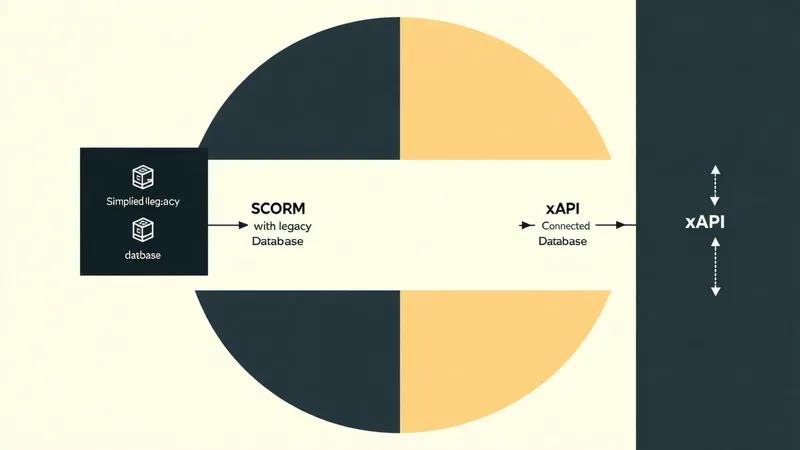
The SCORM vs. xAPI debate has been running in L&D circles for well over a decade. Most of the content you'll find on it reads like a vendor comparison matrix — a table of checkboxes, a declared winner. That framing misses the real question ops L&D leads face: given your workforce profile, your compliance obligations, and your existing HRIS stack, which standard actually changes your day-to-day?
This isn't an argument that SCORM is obsolete or that xAPI is a silver bullet. Neither of those positions survives contact with a real operator rollout. What follows is a practical account of when each standard serves you, where the handoffs get messy, and what cmi5 adds to the picture — because at 2,000-employee scale, the protocol choice has downstream consequences in audit trails, Workday completion sync, and frontline mobile delivery that aren't obvious until you're already in them.
What SCORM 2004 Actually Gives You — and What It Doesn't
SCORM 2004 (4th Edition), published by ADL (Advanced Distributed Learning Initiative), introduced sequencing and navigation controls that SCORM 1.2 lacked. The imsmanifest.xml file governs how content objects relate to each other — prerequisites, branching, attempts. For a structured compliance curriculum — OSHA General Industry 1910 series, for instance, where a test score on Module 3 gates access to Module 4 — that sequencing logic is genuinely useful.
What SCORM 2004 does well: packaging, sequencing, and LMS interoperability in environments that have had a decade-plus to implement the spec. The data model (cmi.* variables, scored interactions, completion status) is stable and widely supported. If you're running Cornerstone OnDemand or a legacy SuccessFactors Learning environment, SCORM 2004 packages will work reliably.
What SCORM 2004 doesn't do well: anything outside the browser session. The SCORM communication model is synchronous and tightly coupled to the LMS — content talks to the LMS via the SCORM API through the browser window. Once that window closes, the session is over. For deskless frontline workers accessing learning on a tablet during a shift or on a mobile device in the field, that session model breaks. There's no native offline support, no multi-device continuity, and no way to capture learning activity that happens outside the LMS-managed package.
We're not saying SCORM 2004 is the wrong choice for every ops scenario — a dispatcher completing a structured annual compliance refresher on a desktop works perfectly well under SCORM. The constraint shows up when you need to track something broader than "did this person finish this package."
xAPI v1.0.3: The Statement Model and Why It Matters for Frontline Ops
xAPI (Experience API, also called Tin Can), finalized at v1.0.3, is built around a different data model entirely. Instead of session-scoped cmi.* variables, xAPI records discrete statements — Actor-Verb-Object triples stored in a Learning Record Store (LRS). A statement looks like:
{
  "actor": { "mbox": "mailto:[email protected]" },
  "verb": { "id": "http://adlnet.gov/expapi/verbs/completed" },
  "object": { "id": "https://lrs.operator.example/activities/forklift-safety-module-2" },
  "result": { "completion": true, "score": { "scaled": 0.87 } },
  "timestamp": "2024-05-14T09:32:00Z"
}
That structure is session-agnostic. Statements can be sent from a mobile app, from an OJT (on-the-job training) tracking tool, from a simulator, from a QR-code scan on the shop floor. The LRS aggregates them regardless of source. For a logistics operator with 2,400 drivers doing DOT-required annual training across multiple mobile devices and dispatch terminals, this matters: you can capture activity across the full learning surface, not just inside the LMS-packaged module.
The trade-off is implementation complexity. SCORM works with any conformant LMS out of the box — you zip the package, upload it, done. xAPI requires an LRS endpoint, proper statement authority configuration, and a clear decision about where the LRS lives relative to your existing HRIS. If your Workday environment isn't configured to receive xAPI completion events, you're now managing a two-system sync problem.
cmi5: The Bridge That Most Ops L&D Teams Haven't Heard Of
cmi5 is an xAPI profile (technically, an ADL specification layered on top of xAPI v1.0.3) that adds launch, session management, and LMS-controlled assignment back into the xAPI model. It's the answer to a real gap: xAPI gave you rich statement capture but removed the LMS's ability to formally manage course assignment and completion certification. cmi5 puts that back.
Under cmi5, the LMS assigns the activity, launches the content, and receives a cmi5 defined statement set that includes passed, failed, and completed verbs with controlled semantics. The content can still talk to an LRS, but the LMS also gets a structured completion signal it can act on — posting to Workday Learning, triggering a recertification reminder, updating a compliance report.
For an operator L&D setup in mid-2024 and beyond, cmi5 is increasingly the right default for new courseware if your LMS supports it. The problem is that LMS support is still uneven — Cornerstone and Degreed have varying degrees of cmi5 adoption, and some learning platforms still treat it as an edge case. Practical guidance: if your priority is Workday completion sync and clean audit trail, check whether your LMS vendor's cmi5 implementation correctly handles the moveOn attribute and session completion timing before committing new content to the format.
The Audit Trail Question: Where Standard Choice Actually Bites You
Consider a regional energy operator (1,800 employees) running OSHA 10 and 30-hour General Industry training across field technicians, maintenance crews, and plant supervisors. The L&D director uses a SCORM 2004 delivery environment. When the OSHA compliance officer requests training records for a specific crew after a recordable incident, the records pull from the LMS completion data — name, course ID, date completed, score. That's adequate for most OSHA 1910 series compliance purposes.
Now suppose that same operator wants to track not just the formal completion event but also the attendance at toolbox talks, OJT sign-offs by supervisors, and refresher micro-modules completed on mobile during morning shift briefings. SCORM's cmi.completion_status field can't capture any of that — those activities don't fit in a SCORM package. The audit trail for OSHA purposes is technically sufficient, but the full picture of workforce readiness isn't captured anywhere.
Under an xAPI-based approach, each of those activities generates a statement. The LRS becomes the authoritative record. Surfacing that record for an OSHA audit or DOT inspection (under 49 CFR Part 380 for commercial driver entry-level training, for instance) requires a reporting layer on top of the LRS — but the data is there and timestamped. The argument for xAPI in high-compliance environments isn't that it makes audits easier (initially, it makes them more complex to set up); it's that it makes the underlying record more complete.
Making the Practical Decision
For most ops L&D leads running a 1,500–3,000 employee workforce in 2024–2025, the choice isn't binary. The realistic architecture is a hybrid:
- SCORM 2004 or SCORM 1.2 for existing packaged content in your LMS catalogue — no reason to reauthor unless you have a specific gap it can't address
- xAPI statements for activities that happen outside the LMS: OJT sign-offs, mobile micro-modules, simulator completions, JIT (just-in-time) learning captures on the floor
- cmi5 for net-new formal courseware if your LMS vendor's implementation is confirmed stable — specifically if Workday Learning completion sync is a requirement
The question to ask your LMS vendor (or learning layer vendor) is specific: does a completed cmi5 course trigger a Workday Learning activity completion record the same day, without a manual CSV export step? If the answer involves a nightly batch file or a manual reconciliation step, you don't actually have the integration you think you have.
At Kurios, the integration question is one we address at the point of path configuration — not after the fact. The standard choice should follow the delivery surface and the audit requirement, not the other way around. Pick the protocol that fits your data model, verify the Workday sync end-to-end in a staging environment before you roll out to even one cohort, and document the LRS authority configuration. The compliance conversation with your auditor will be shorter for it.