The Individual Development Plan was supposed to be a living document. In most large operator environments, it functions as an annual review artifact — completed in January with the right intentions, not touched again until the following January when someone discovers the template in a shared drive and starts over. The employee whose IDP it is may not have thought about it since the performance review conversation. Their manager has a supervisor of their own with a full operational plate.
The IDP problem at scale isn't motivation or design. It's maintenance overhead. At a logistics operator with 2,400 employees, building and maintaining individualized development plans requires a level of L&D bandwidth that simply doesn't exist. If you have two L&D staff supporting that workforce — which is a typical staffing ratio for an operator at that scale — you cannot manually curate 2,400 active development tracks. The math doesn't work. Automation isn't a nice-to-have; it's the only architecture that makes IDPs functional across a large ops workforce.
What "IDP Automation" Actually Means in an Ops Context
When L&D vendors talk about IDP automation, they sometimes mean a system where employees self-select goals from a library and a recommendation engine surfaces related content. That's not what we're describing here. Self-selection-based IDPs fail at the same rate as paper IDPs in frontline ops environments, because the motivation and bandwidth to actively curate your own development aren't uniformly distributed across a workforce — especially not for deskless workers on the floor or in the field.
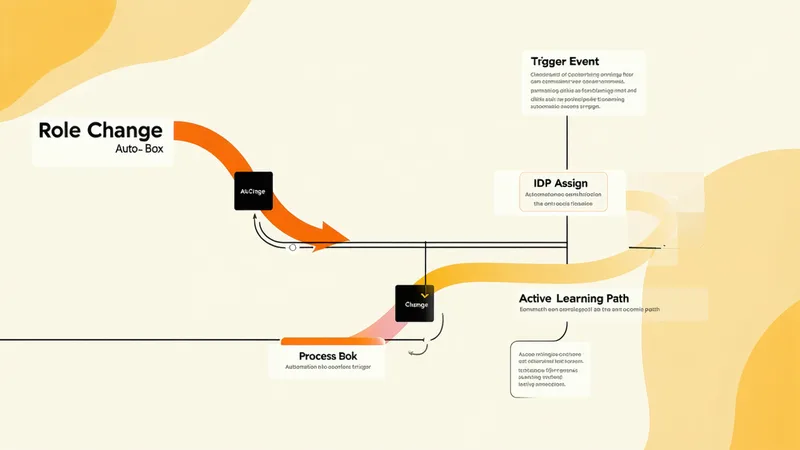
Automation in an ops L&D context means the system triggers IDP-relevant path assignments based on observable events in the HR data stream — without requiring either the employee or their manager to initiate. The observable events are:
- Role event: new hire, promotion, lateral move, or supervisor designation — triggers assignment of the appropriate role-mapped learning path for the destination job family
- Tenure milestone: 6-month, 12-month, 24-month marks — triggers assignment of the next progression tier in the current job family track, or a skills gap assessment prompt
- Competency completion: a worker completes a defined competency domain — triggers automatic activation of the adjacent domain in the path sequence, or triggers a supervisor check-in prompt
- Compliance calendar: annual or periodic recertification requirements (OSHA refreshers, DOT required annual training under 49 CFR Part 380) — triggers assignment based on the worker's role profile and last completion date
These triggers are defined by the competency framework and the learning architecture. They're not ad hoc decisions. Once the trigger-to-assignment mapping is configured and tested, the IDP becomes a byproduct of role-linked events rather than a manual curation task.
The Workday Hook: Making HR Events the Trigger Layer
The most durable IDP automation architecture in an enterprise ops environment routes through the HRIS event stream. In a Workday implementation, worker events (hire, position change, supervisor change, location transfer) generate notifications that can be consumed by downstream systems. If your learning platform is integrated via the Workday Connector or WD Studio API, those events can directly trigger learning assignments without any manual handoff.
The configuration is: define which Workday event types trigger which learning plan templates, mapped by job family and level. A promotion event for a worker in the "Field Technician" job family moving to a supervisory grade triggers the supervisor track assignment. A new hire event for a worker in the "Dispatch Operations" family triggers the dispatch onboarding path plus the required OSHA and DOT compliance curriculum for that role.
One practical consideration: Workday event webhooks have latency — the event fires when the business process completes in Workday, which may be days after the effective date of the change. For a promotion effective on March 1 that goes through a Workday approval chain and closes March 4, the learning assignment triggers on March 4. For most use cases this is fine. For new hire onboarding where you want Day 1 learning access, you need either a pre-provisioning step or a manual override that doesn't wait for the Workday process to close. Design for this exception explicitly — it's the case that creates the most noise in ops onboarding.
Supervisor-Led vs. System-Assigned: Getting the Balance Right
Automation handles the predictable — the competency domains every worker in a job family needs, the compliance assignments the regulation requires, the progression milestones that apply universally. What it can't replace is the context-specific conversation a supervisor has with an individual worker about their development direction.
We're not saying supervisor-driven IDPs are obsolete. What we're saying is that the supervisor's contribution should be additive to an automated foundation, not the foundation itself. If the automated track handles 80% of what belongs in every employee's development plan — the role competencies, the compliance requirements, the standard progression path — then supervisor conversations can focus on the 20% that's genuinely individual: career direction preferences, stretch assignment interest, skill gaps surfaced by the manager's observation of daily work.
A useful test for whether your IDP architecture is correctly distributed: if a supervisor goes on leave for three months, do the development plans for their direct reports continue to progress? Under a fully supervisor-dependent IDP model, probably not. Under an automated trigger model, the standard path continues regardless of the supervisor's availability. The supervisor's absence affects the quality of the personalized layer, not the existence of the development track.
Measuring IDP Effectiveness: Path Progress vs. Competency Attainment
The automation architecture is only as useful as the measurement layer on top of it. Most operators track IDP effectiveness by whether the plan was created and whether modules were completed. Neither of those is a meaningful indicator of development progress — the first is an administrative artifact, the second is a completion rate that may or may not correspond to actual skill attainment.
At a manufacturing operator (1,200 plant staff across three facilities) that built role-mapped automated IDPs for supervisor-track candidates, the most informative metric turned out to be the gap between path completion and verified competency. Workers could complete the self-paced modules quickly, but the OJT sign-off on the relevant competency domain — which required the supervisor to observe and confirm the skill — lagged by weeks in some cohorts. The bottleneck wasn't motivation or content quality; it was supervisor availability for structured observation. Surfacing that metric allowed the L&D director to advocate for blocked time in the operations schedule for supervisor-led assessments — a conversation that wouldn't have been possible without the data.
The most important thing an IDP automation system needs to produce is not a completion percentage. It's a visibility layer: who is progressing against their development track, where the bottlenecks are, and which cohorts or job families are falling behind relative to the path design. That visibility, connected to role mapping and delivered through Kurios path analytics, is what lets an L&D lead make an evidence-based case for operational changes — not just report on learning activity. Completion events captured as xAPI statements per ADL's xAPI v1.0.3 specification give the system a granular, timestamped development record that feeds both the visibility layer and any downstream compliance reporting requirements tied to the role.